Material · Polyamide (Nylon / PA)
Nylon Rope
The strongest of the common synthetic rope fibers, with high elasticity that absorbs shock loads — the classic choice for anchor, mooring and dock lines.
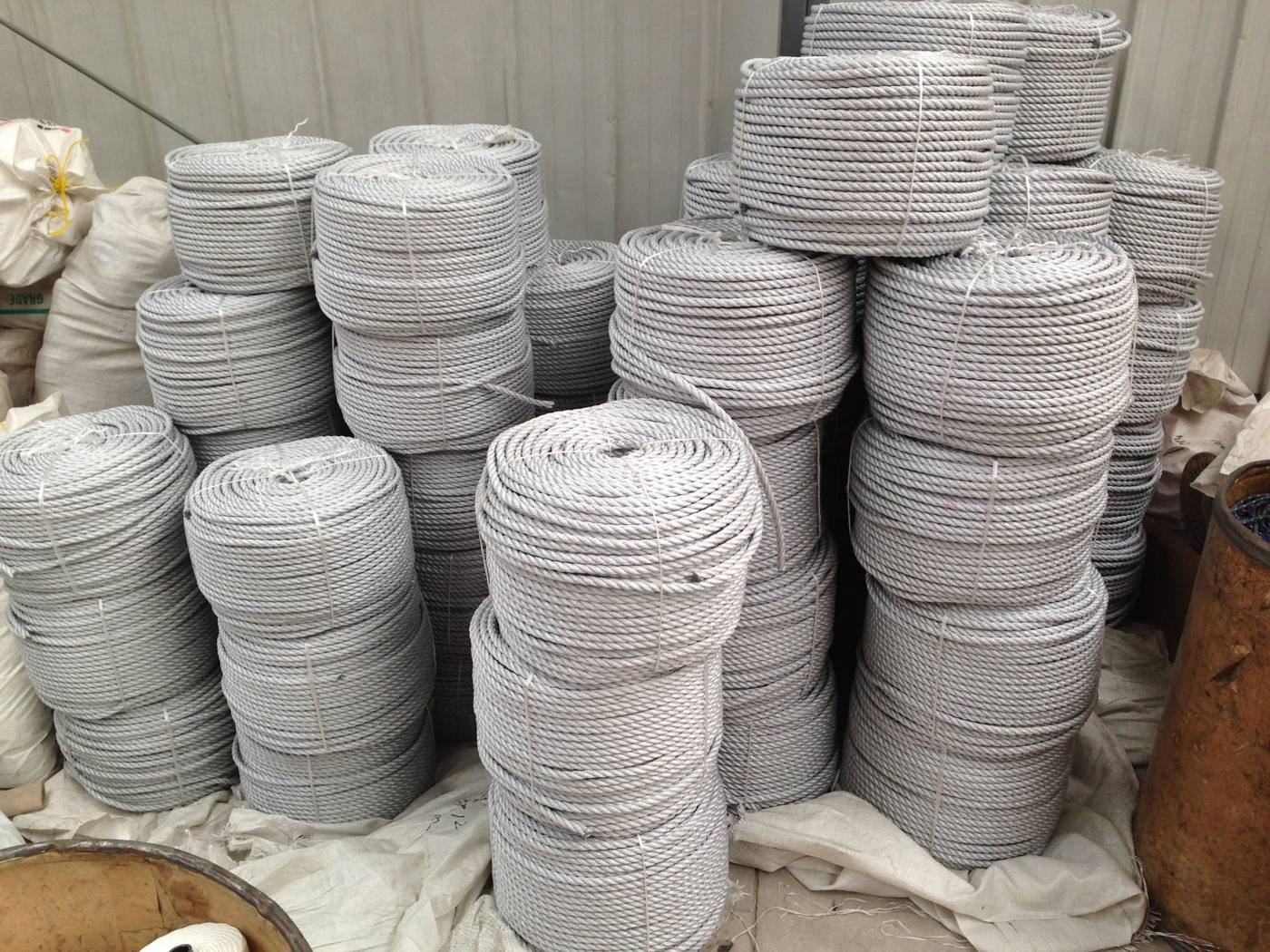
| Floats on water? | No — sinks |
|---|---|
| UV resistance | Good |
| Stretch behavior | High — excellent shock absorption, poor dimensional stability |
| Water absorption | Absorbs water; can lose roughly 10–15% strength when wet (recovers when dry) |
| Handling feel | Smooth, dense, heavier in hand than PP/PE |
| Property detail | |
|---|---|
| Specific gravity | ~1.14 — sinks in water |
| Strength | Highest of the common synthetic fibers (PP/PE/nylon/polyester) |
| Elasticity | High elongation — absorbs dynamic and shock loads |
| Wet strength | Temporarily reduced when wet; recovers on drying |
| Abrasion resistance | Very good |
| Relative cost | Higher than PP/PE |
Nylon is the performance fiber of the classic marine world. Its defining property is elasticity: a nylon rope stretches significantly under load and recovers, which turns sudden jerks — a boat surging against a dock, an anchor line snubbing in waves — into absorbed energy rather than a shock to fittings and cleats.
The same elasticity is a disadvantage where length stability matters. Nylon also absorbs water, which temporarily reduces its strength and adds weight; for permanent outdoor rigging where low stretch is required, polyester is normally preferred.
For buyers, the practical rule is simple: choose nylon when the line must absorb dynamic loads (mooring, anchoring, docking); choose polyester when it must hold position (flagpole halyards, long-term rigging).
Best suited for
- Anchor and mooring lines (elasticity absorbs surge loads)
- Dock lines for boats
- Applications where shock absorption matters more than low stretch
Usually not the right choice for
- Applications needing low stretch or precise length under load
- Long immersion where wet-strength loss is unacceptable
- Buyers optimizing purely for lowest cost
Need a Polyamide (Nylon / PA) product quoted?
Send the target construction, diameter, length, quantity, packaging and application for review.
Constructions made from Polyamide (Nylon / PA)
3 Strand Twisted Rope
The classic rope construction: three strands twisted in a spiral. Economical, easy to inspect and the easiest construction to splice.
Double Braided Rope
Braid-on-braid: a braided core inside a braided cover, sharing the load. The premium marine construction for dock lines and rigging.
8 Strand Plaited Rope
Eight strands plaited in pairs — a square-ish, torque-free large-diameter rope. The workhorse mooring construction for commercial marine.
Products in Polyamide (Nylon / PA)
Related reading
Rope Materials Compared: PP vs PE vs Nylon vs Polyester vs Cotton
The five common rope fibers on one table: buoyancy, strength, stretch, UV life, wet behavior and cost — and the one-line rule for when each material wins.
Twisted Rope vs Braided Rope: A Buyer's Comparison
Twisted rope is cheaper and spliceable; braided rope handles better and never kinks. Which construction fits your application — and what each costs you.
Marine Rope Buying Guide: Anchor, Mooring, Dock & Utility Lines
Nylon for shock absorption, PP for floating, polyester for position holding — how to choose marine rope by line function, with specification tips for mooring RFQs.